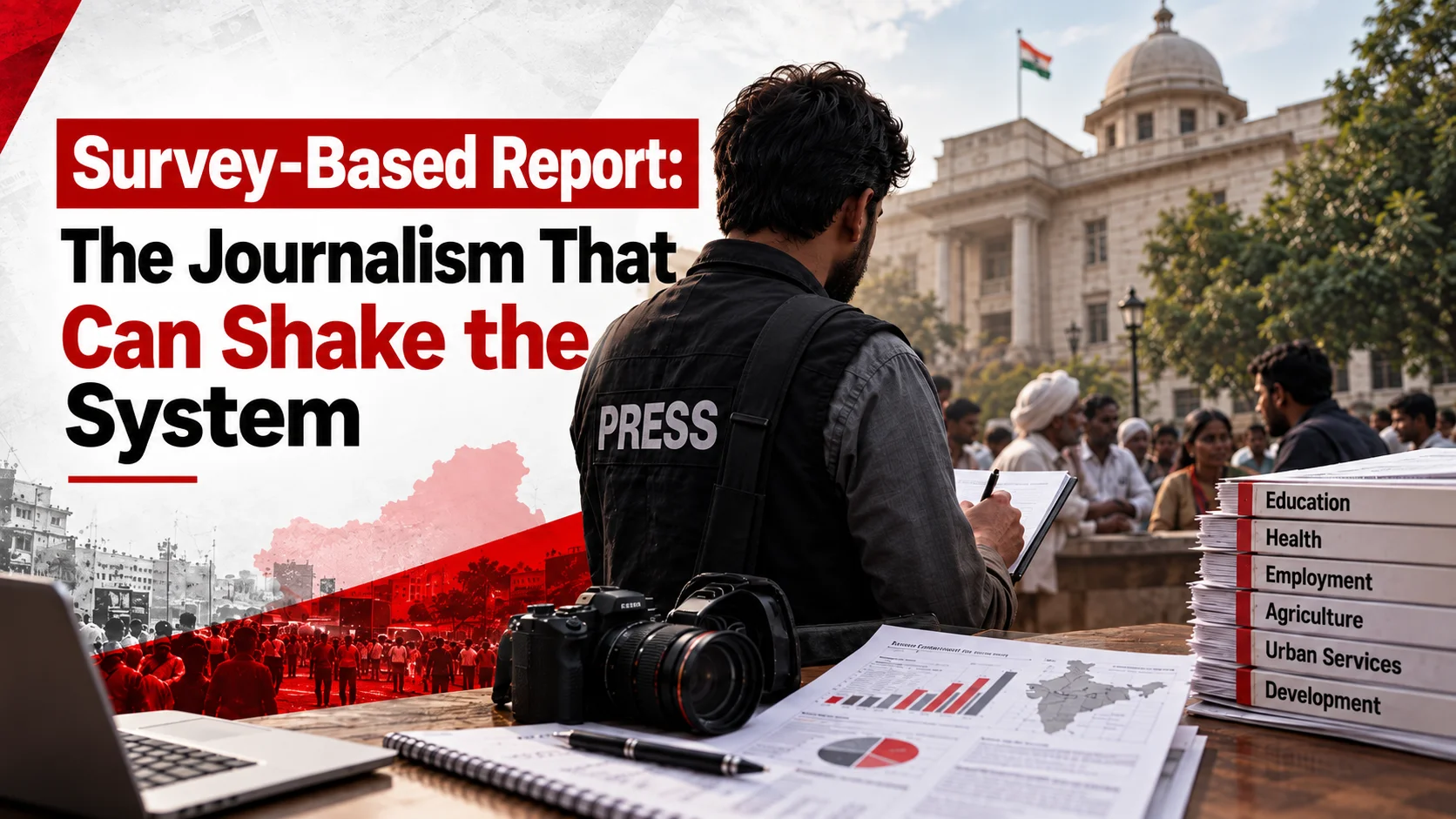
Survey-Based Reporting: Journalism That Can Shake the System
The Difference Between a Scoop and a Report
Officials know they just need to stay quiet for a while, and the storm will pass on its own. But survey-based reporting is entirely different.
The Scoop
A scoop lasts for two days. It is published in the morning, discussed until the afternoon, and buried by new news the very next day. It typically questions a single incident.
The Survey Report
It questions the entire system. It shows exactly where the entire district stands in a specific sector,backed by data, public testimonies, and the department's own responses. It presents proof, not just allegations.
Most importantly, when such a report reaches higher authorities, the pressure comes from above, not below. Real movement happens only when a senior official or public representative questions a local competent authority about the findings of your report. Local officials are experts at handling local pressure, but they cannot escape questions from their superiors. This is the true power of survey-based reporting.
What is Survey-Based Reporting?
In simple terms, it is a report containing minimal personal opinion and maximum evidence. Its foundation rests on evidence gathered from three distinct directions.
- Public Testimony: You ask a specific set of questions to a targeted number of people in a defined area and record their answers. It stops being an individual complaint and reveals a broader pattern.
- Beneficiary Experience: You speak to the actual people who were supposed to receive a service or scheme. You ask them what they received, how much, when, and after how many hurdles.
- Government Data and Official Stance: You include the government’s own data (what should have happened on paper) and the relevant official’s response. The official's quote must be included in every report.
When these three elements combine, the report becomes robust and safe. Public testimony shows the ground reality, government data shows the claims, and the gap between the two becomes your core news story. The official's stance keeps the report balanced and ensures you are standing on facts rather than accusations.
Six Reports That Can Shake the Entire District
Do not create scattered news on random topics. Run these six subjects as continuous, month-after-month series to maintain pressure.
Developed India, Developed City Report
Flagship Campaign Largest ImpactThis is the largest and most impactful series. The question is simple: Why is our city lagging behind the dream of a 'Developed India', and where exactly is it falling short? Evaluate your city on basic parameters like roads, water, electricity, cleanliness, digital access, employment, and education. Show the target, the current reality, and the gap for each parameter. This series acts as an umbrella for the other five, so treat it as your flagship campaign.
Our City Lagging in Education
Emotional ConnectionThis series connects deeply on an emotional level because every family is concerned about their children's education. Raise two questions. First, how many talented individuals have emerged from our city, what were their stories, and where are they now? Second, and more importantly, why do so many fail to rise today? Are there teachers in schools? What is the condition of the buildings? Where do children have to go for higher education, and what happens to those who cannot leave? The stark contrast between past glory and present conditions raises the sharpest questions.
The State of Employment and Self-Employment
Widely ReadThe core question here is why the city isn't generating jobs. Investigate why local youth migrate for work, the condition of local industries, why previous units shut down, and the ground reality of self-employment and skill development schemes. Ask beneficiaries if they received loans or found work post-training. Employment is a concern in every household, making this the most widely read series.
The Status of Healthcare Facilities
Ground RealityGround checks yield the clearest results here. Look at the number of vacant doctor posts, medicine availability, working vs. broken diagnostic machines, conditions of maternity and emergency wards, and how frequently patients are referred to bigger cities. Speak to patients and their families, and compare their experiences with the government hospital's data. The gap between claims and reality is often massive here.
The State of Agriculture
High EffectivenessIn regions where farming is the foundation of life, this series touches the most lives. Keep the questions concrete: Are fertilizers available on time? Are the seeds authentic? Are farmers receiving timely payments for their crops? How many days do they have to wait at procurement centers? What is the status of crop insurance and compensation? Combine this with what the government claims to be doing. Merging farmer testimonies with procurement center data makes for a highly effective report.
Civic Amenities (Urban and Rural)
Daily LifeThis is a daily life series where people recognize their own struggles the most.
- Urban areas: Focus on water supply, sanitation, drains, streetlights, roads, and waste management.
- Rural areas: Focus on approach roads, drinking water, electricity, rations, and toilets.
Keep urban and rural reports separate, as their problems and responsible departments differ. This topic never gets old, so keep it regular.
Impact Happens Only When the Report Reaches the Top
Understand this clearly: the real impact of a report doesn't come from merely publishing it, but from it reaching the right places. If a good report remains only on your local portal, it is just another news item for the local official. But when that same report steps outside the district to the state level, reaching senior department officials and public representatives, its weight changes entirely.
The Dual-Direction Strategy
Therefore, drive every series in two directions:
- Downwards: To your local readers via your portal and WhatsApp.
- Upwards: On social media platforms like X (formerly Twitter), where bureaucrats, politicians, and policymakers are active. When questions come from the top down, the local system is forced to answer, and that is where real change begins.
How the Work is Divided
This is where most portal owners stop, thinking, "How will I handle such large surveys and data alone?" You do not have to do this alone. The division of labor is clear:
You will prepare the field data
This is the part only you can do. Using your reporters to ask questions, reach beneficiaries, gather genuine pictures and testimonies from villages and neighborhoods, and secure the local official's quote.
MOJO will bring the research data
This is the framework that makes the report strong and comparable. MOJO decides how the survey should be conducted, crafts the questions, determines sample sizes, analyzes the data, and structures the final report.
Publish a joint report
Together, you will publish a joint report combining your ground-level grip with the network's systematic research methodology. This elevates your work from mere news to a trusted document.
(If you face difficulties in preparing a survey, creating questions, or molding field data into a report, speak to a MOJO Network representative.)
Rules for Maintaining Trust
The entire power of a survey-based report rests on trust. A single weak report can destroy the credibility of the whole series. Strictly adhere to these rules:
Keep the methodology transparent
Clearly state in the report how many people were surveyed, in which areas, on what dates, and how the questions were asked. Hidden methodologies breed suspicion.
Always include the official's stance
Even if they refuse to comment, explicitly state that they were asked but did not respond. This protects you from accusations of bias.
Do not inflate numbers
Write exactly how many people you asked. Do not present a small sample size as the absolute truth for the entire district; state clearly that it is an indicator to be explored further.
Keep opinions and facts separate
The job of the report is to show, not to pass judgment. Present the gap to the readers and leave the conclusion to them,this gives the report maximum weight.
Handle beneficiary data carefully
Only publish the identity of someone you spoke to if they explicitly consent; otherwise, keep them anonymous. A vulnerable person's testimony should not become a source of trouble for them.
Conclusion
Ordinary news tells people what happened. Survey-based reporting reveals exactly where the entire system stands, and those are the questions that make the establishment uncomfortable.
If you run these six series month after month,armed with evidence and ensuring they reach the top,your portal will transcend being just a news site. It will become the district's most trusted watchdog platform. Your fieldwork, combined with the network's research framework, creates a report that no one will find easy to ignore.