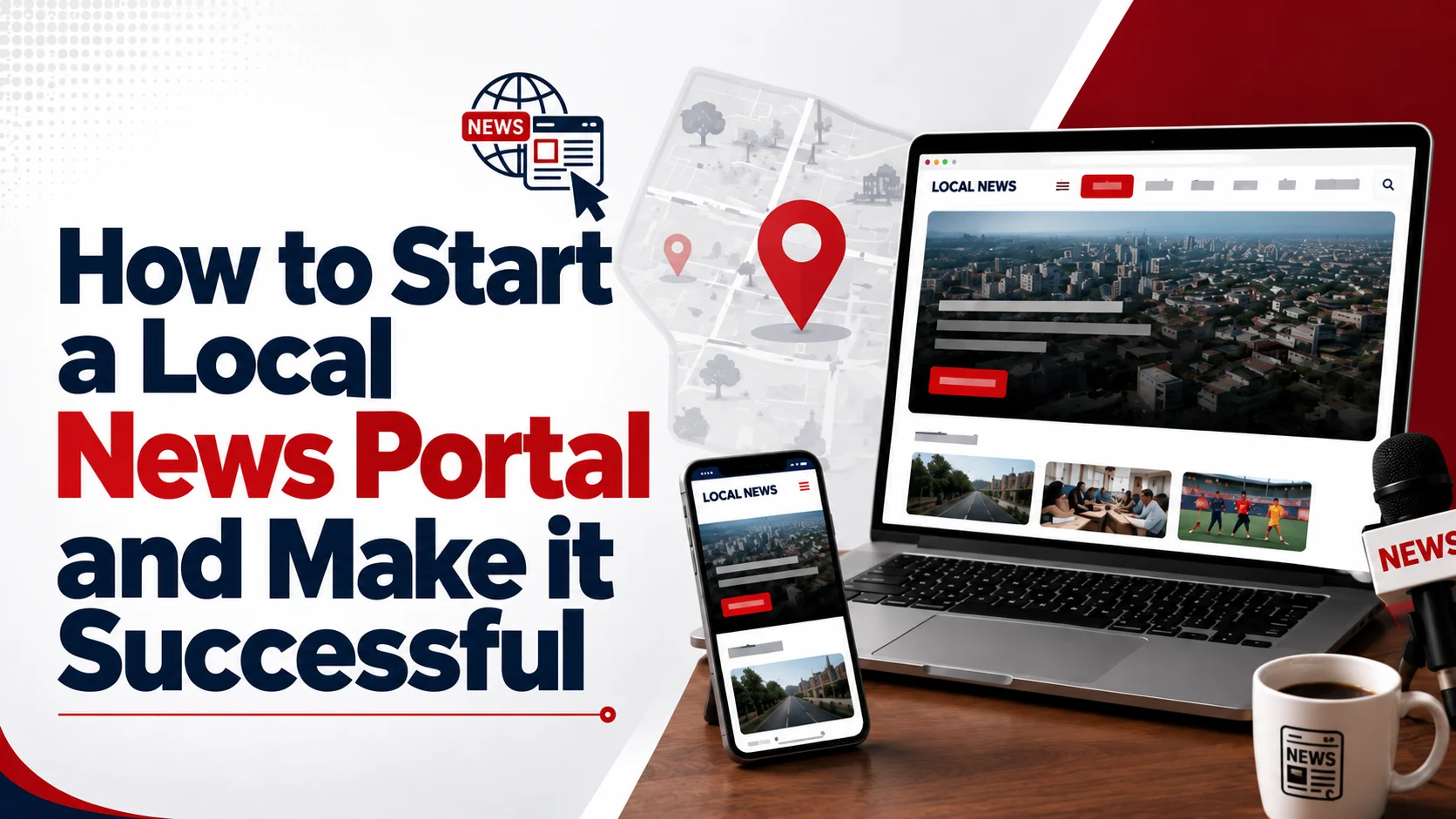
How to Start a Local News Portal and Make it Successful
This guide is divided into two parts. The first part covers the foundational framework of setting up the portal, and the second part details the 17 actionable steps that make a portal widely read and profitable.
Part 1: The Foundation of the Portal
Niche & Region
Tech & Legal
Distribution
Define your beat, region, or topic:
Do not try to cover the entire state or every subject. Choose a specific district, 4-5 wards of a large city, or a specific niche like Politics, Employment, Spirituality, Sports, or Bollywood. The smaller your coverage radius, the deeper your grip on the community and the stronger your local advertising market.
Name and Domain:
Include the location's name in your domain (e.g., pannanews.com or bhopalkhabar.in). People naturally search for place names on Google, which gives you an immediate SEO advantage.
Technical Setup:
Build a clean, fast-loading, mobile-first portal. Ensure proper category structuring, submission to Google News and Google Search Console, and integration of Web Stories. Since 90% of your traffic will come from mobile devices, do not waste excessive time on desktop design.
Legal Preparation:
It is mandatory under the IT Rules 2021 for digital publishers to display the Editor's name, address, contact details, Privacy Policy, Grievance Redressal Officer, and Grievance Policy on the portal. Additionally, maintain a firm/company registration, GST number, and a current bank account, as government and corporate advertisements cannot be processed without them.
Distribution:
A portal does not run in isolation. From day one, create a WhatsApp Channel, Facebook Page, Instagram account, and YouTube channel. Readers discover news on social media and click through to read it on the portal.
Part 2: 17 Actionable Steps to Make Your Portal Successful
Optimal Content Mix Strategy
1Create a List of Evergreen Stories:
Breaking news lasts for two days, but evergreen content lasts for two years. Compile and publish permanent local information: addresses and timings of government offices, hospital directories, blood bank and ambulance numbers, bus/train schedules, school/college lists, tourist spots, local cuisines, market (mandi) prices, and guides on how to get birth/death certificates. These are searched on Google year-round and provide steady traffic. Review and update the dates and details once a year.
2'Top of the Town' Rating Stories:
Rank the best things in your city and publish them as articles, videos, and reels. Examples include: the 5 best tea stalls, 3 cleanest restaurants, top coaching institutes, most popular sweet shops, or best morning walk spots. This content is highly shared because the featured businesses will share it with their own customers.
3Conduct Voting on Local Issues:
Run a weekly poll on a pressing local issue (e.g., "Should vehicles be banned in the main market?", "Are you satisfied with municipal cleanliness?", or "Which flyover should be built first?"). Post the poll on the portal, WhatsApp, and Instagram. Launch it on Monday and publish the results on Friday. This makes readers active participants and gives you an exclusive, original news story every week.
4Tell the History of Your City:
Every city has untold stories. Cover old mansions, princely state history, the city's role in the freedom struggle, century-old shops, renamed bridges, or historic fairgrounds. Interview elders, collect archival photos, and cross-check facts with district gazetteers. This series transitions your portal from a mere news shop to a memory keeper of the city, building true brand value. One episode a week is sufficient.
5Start Seasonal Series:
Launch targeted series for specific seasons and events. Examples: "Meritorious Students" during exam results, "Exquisite Outfits & Jewelry" during wedding season, "Festival Specials" during holidays, or "Summer Specials" during vacations. This adds variety, maintains reader interest, and attracts highly targeted seasonal advertisers.
6Weekly Special Interviews ('Meet Them'):
Publish a special interview with a prominent or influential local personality every Saturday. Feature administrators, politicians, industrialists, educationists, doctors, social workers, or young talents. This gives readers inspiring insights and creates a distinct, regular identity for your platform.
7Direct Audience Interaction ('You and Us'):
Host regular interactive sessions (webinars, video conferences, or live streams) where audiences can ask direct questions, share opinions, and interact with experts or special guests. This significantly boosts engagement and strengthens audience trust.
8Review Government Schemes Ground Reality:
Simply publishing government announcements isn't journalism. Pick one scheme a month (e.g., Housing, Ujjwala, Ayushman, water supply, scholarships). Pull official data on registered beneficiaries, visit 2-3 villages to verify what was actually received, and get a quote from the relevant official. Combining data, ground verification, and official statements makes your report bulletproof.
9Scrutinize Public Representatives' Funds:
Expenditure details for MLA and MP funds are public. Obtain this data from planning offices, portals, or via RTI. Report on how much was allocated, where it was spent, and identify projects that are complete on paper but incomplete on the ground.
10Rate Public Representatives (Survey-Based):
Only publish ratings backed by an actual survey to maintain credibility. Ask a set number of people 4-5 questions regarding an official's availability, development work, and grievance redressal. Clearly state your sample size, dates, regions, and methodology. Conduct the first survey well before elections and repeat it every six months for comparison.
11Monthly Departmental Report Cards:
Publish a standardized monthly report card for key departments: Police (cases filed, solved, crime rates), Health (vacant doctor posts, medicine availability), Municipality (cleanliness, water, streetlights), Schools (teacher attendance, mid-day meals), and Rural (MNREGA days, roads). Once the format is set, you only need to update the numbers monthly. This consistency makes you the district's reference point.
12Build a Citizen Journalist Network:
You cannot be everywhere at once. Publicize a WhatsApp number where citizens can send photos, videos, and local updates. Give credit to good tipsters in your articles, and award certificates/small honors to the top 5 contributors monthly.
13Host Ground Events:
Your brand needs physical visibility. Organize health/eye checkup camps, career guidance seminars, talent awards, or cleanliness drives. You don't need to bear the costs,hospitals, coaching centers, and local brands will sponsor these to get direct access to their target audience. Events bring sponsorships, a full day of exclusive content, local prestige, and loyal readers.
14Online Competitions:
This is the fastest, cheapest way to acquire readers. Host contests like Kitchen Queen, best monsoon photo, best Rangoli, or children's painting. Accept entries via WhatsApp, display them in a portal gallery, and decide winners through a mix of jury and public voting. Get prizes sponsored by local shops. Participants will share your links extensively to get votes.
15Hire Sub-Reporters:
To expand coverage, appoint stringers in every tehsil, block, and major ward. Do not issue press ID cards without background checks, as misuse will ruin your credibility. Issue clear appointment letters outlining a strict code of conduct (no extortion). A model combining a fixed base pay with a commission on ads they bring in is usually the most practical.
16WhatsApp Ads with Affiliate Links:
WhatsApp is the fastest route for local ads. Give advertisers a custom tracking link (to their website, catalog, or direct WhatsApp chat). Show them analytics at the end of the month proving how many clicks or inquiries your portal generated. Local shopkeepers understand leads better than print-ad jargon.
17Launch Discount Coupons:
Partner with local businesses to offer your readers 10-20% off. Publish these as daily or weekly offers. You earn through shop listing fees, commissions on redemptions, or by finding sponsors for festive "coupon books" during Diwali, wedding seasons, or school admissions. This makes your portal a utility,people read news when something happens, but they check for coupons every week.
A Practical 3-Month Roadmap
Month 1: Foundation & Setup
Set up the portal, legal pages, and social media channels. Make a list of 30 evergreen stories and publish the first 10. Reach your first 500 members on the WhatsApp channel.
Month 2: Engagement & Expansion
Launch the 'Top of the Town' series and weekly polls. Publish your first government scheme review. Appoint 2 sub-reporters and pitch advertising to your first 10 local businesses.
Month 3: Monetization & Community
Host your first online competition. Publish the first monthly departmental report card. Launch the discount coupon program and activate your citizen journalist network.
Conclusion
The success of a local news portal does not come from breaking news; it comes from consistency. A portal that offers a poll every Monday, a history piece every Wednesday, a departmental report card on the 1st of every month, and discount coupons every Friday is the one readers will remember and return to.
Technology and design are the easiest parts of the job today. The hardest part is building trust. Trust is built purely through facts, transparency, and consistency. These three elements are your portal's true capital.