
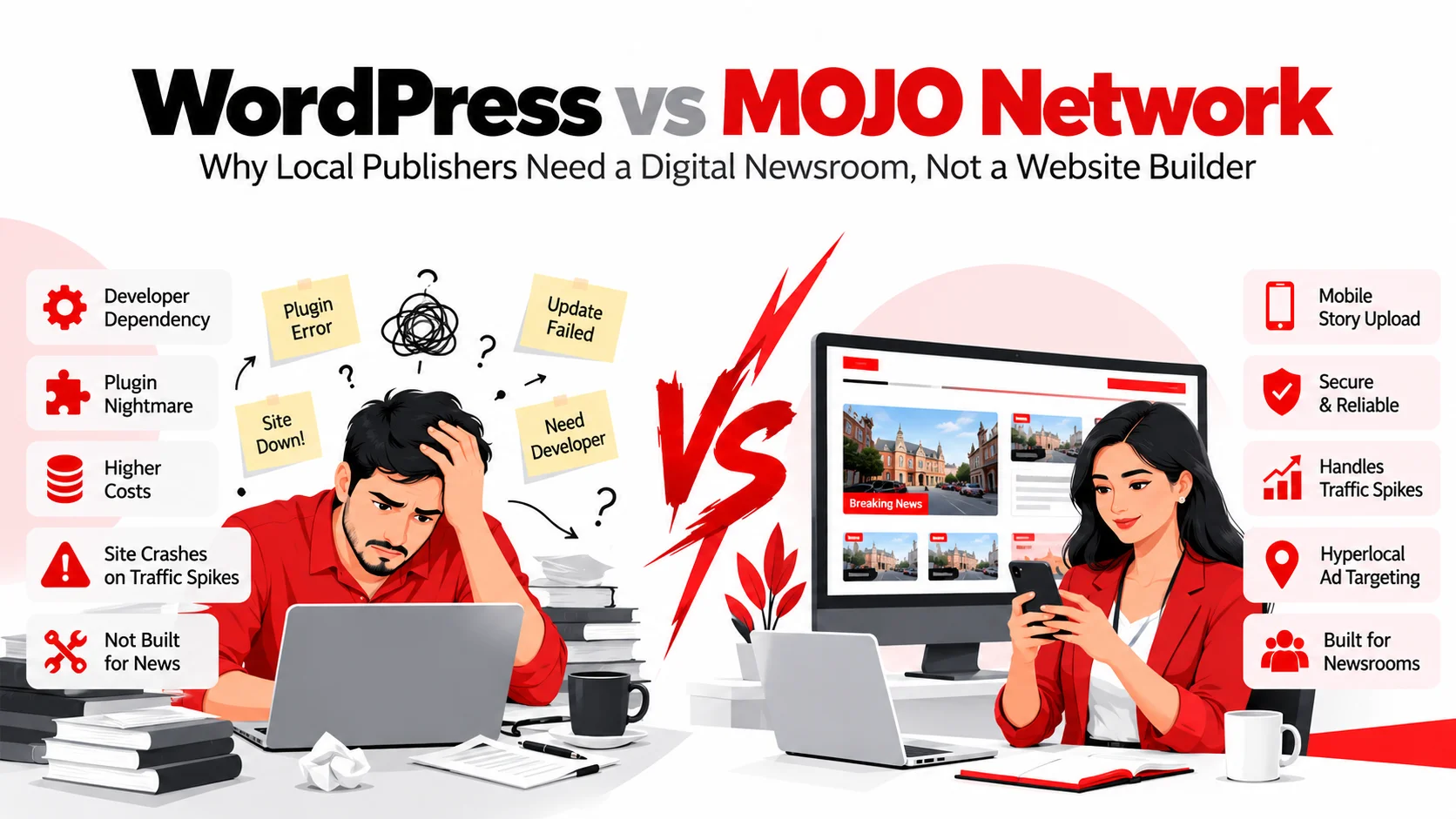
WordPress vs MOJO Network: Why a Generic Website Can Never Be a Real Newsroom
A WordPress website and a digital newsroom are not the same product, even when they look similar on day one.
WordPress is built for the general purpose of running any kind of website. A newsroom has to survive traffic spikes, publish from the field, and sell local ads at scale. That gap is where most local publishers get stuck.
Every publisher makes this decision on day one, and most get it wrong
Most local publishers and journalists make their biggest mistake before they publish a single story: they pick the wrong platform. A developer installs a cheap WordPress theme, a few local updates go up, and it feels like a news portal has been born.
For the first few months, it is cheap, fast and exciting. Then month six arrives. The site crashes right in the middle of a viral story. A plugin update breaks another plugin overnight. A simple sponsored banner needs the same developer you already paid, paid again.
The lesson underneath all of it is simple: a basic website is not a newsroom. Big brands and serious readers expect speed, structure and reliability. You need a digital newsroom built to scale your local journalism, not a generic blogging tool bent into the shape of one.
The WordPress trap: why it fails local publishers
WordPress is the most popular website builder in the world, but it was never built for news. It is a general purpose platform that publishers try to force into a newsroom shape, and the cost of that gets paid daily by the journalist on the ground.
Complete developer dependency
Want to change a layout or add a sponsored local banner? You cannot do it yourself. You end up waiting on a developer, spending more time chasing IT help than chasing the news.
The plugin nightmare
Running a WordPress news site usually means stacking 15 to 20 different third party plugins. The moment one of them updates and clashes with another, your entire site can go down, often with no warning.
A high technical barrier
You end up learning about server caching, security patches and cryptic error codes, none of which has anything to do with journalism. Your time is your real capital. It should go into ground reporting, not into fixing a server.
Not built for news
A generic website is not optimised for breaking news formats, hyperlocal categorisation, or the fast data collection that modern reporting needs. It is a system that quietly holds you back, story after story.
Where your time and money quietly go on WordPress
- A developer on retainer, for changes you should be able to make yourself
- Plugin licences that need renewing, often across 15 or more plugins
- Security monitoring and backups, so one bad update does not wipe out your site
- Hosting upgrades, the moment your traffic actually starts to grow
- Your own hours, spent troubleshooting instead of reporting
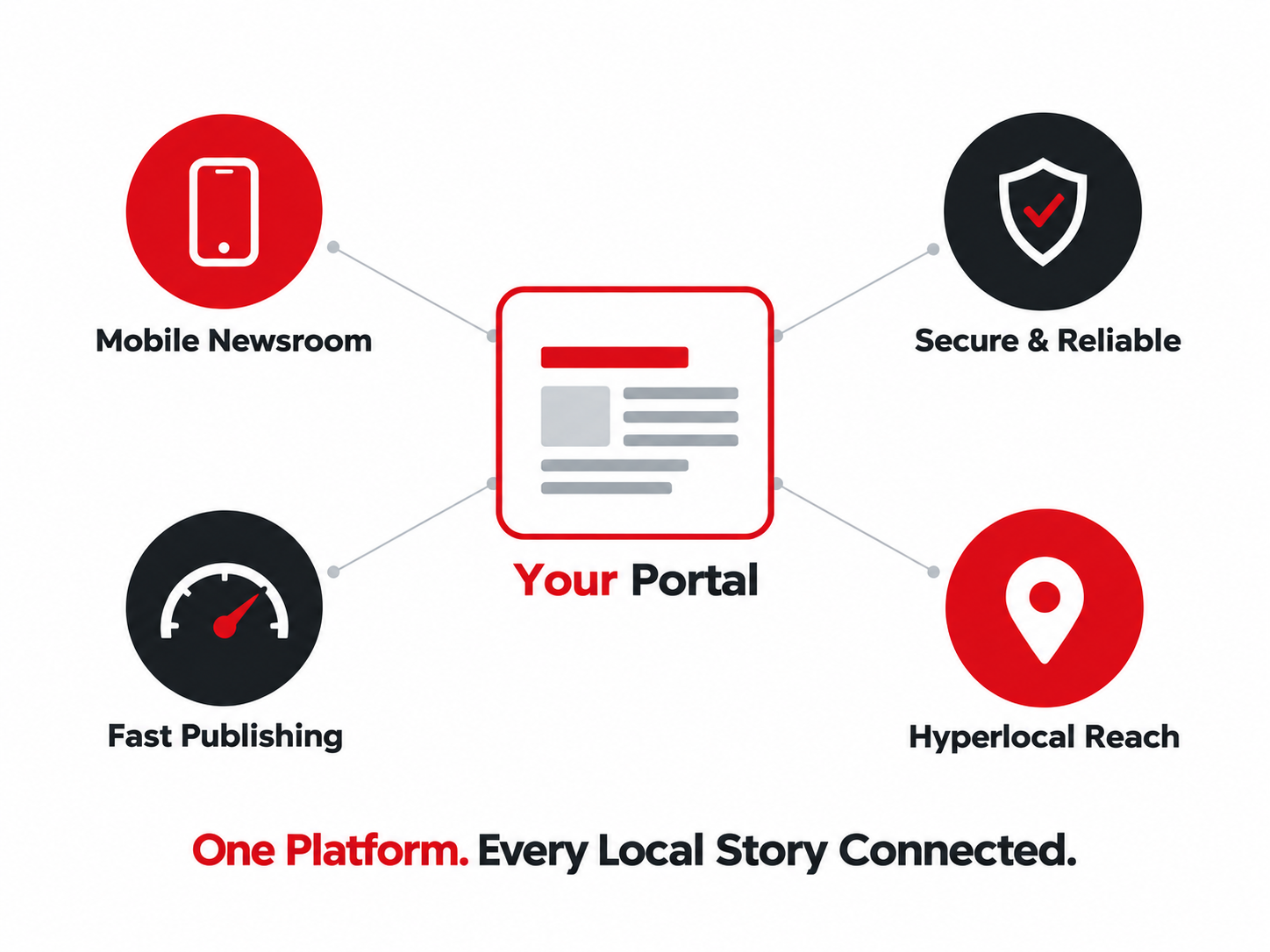
MOJO Network: the power of a true digital newsroom
MOJO Network is designed only for digital publishers and local news portals. It removes the technical friction completely, so you can focus on what actually brings in revenue: your content and your community.
Built specifically for newsrooms
This is not a generic builder stretched to fit. It is a dedicated ecosystem engineered to handle breaking news, survey reports and high volume local traffic without drama.
An all in one platform
You do not need separate hosting, premium themes or a shelf of plugins. Everything you need to run campaigns and publish news is already built in.
Easy to use, no coding required
Your ground team can upload stories straight from the field, from their phones. The interface is built for journalists, not for coders.
A genuine hyperlocal focus
The infrastructure natively supports pin code targeted advertising and local business integrations, which lines up directly with how local publishers actually make money.
Fast, secure and reliable
When one of your stories gets picked up and traffic spikes, your site stays up. MOJO carries the technical load, with built in support behind it.
WordPress vs MOJO Network, side by side
| What matters | WordPress + plugins | MOJO Network |
|---|---|---|
| Built for | General websites and blogs | Hyperlocal news publishing |
| Getting started | Theme, hosting, plugins, a developer | Ready newsroom, publish the same day |
| Coding needed | Yes, for most changes | No |
| Plugins to maintain | 15 to 20, often conflicting | Built in, nothing to install |
| Traffic spikes | Can crash the site | Built to handle spikes |
| Mobile field reporting | Needs extra plugins or apps | Native mobile story upload |
| Local ad targeting | Needs custom development | Native pin code targeting |
| Who fixes it when it breaks | You, or a developer you pay again | MOJO's technical team |
| Your actual job, most days | Managing the website | Managing the newsroom |
The division of labour: your job vs MOJO's job
The fastest way to fail in local media is trying to do everything yourself. The MOJO model runs on a clear division of labour.
| MOJO's job | Your job |
|---|---|
| Managing servers and site speed | Ground execution, story by story |
| Keeping security airtight | Gathering public testimony |
| Fixing bugs before they cost you readers | Scrutinising official data |
| Running the technical infrastructure behind campaigns | Building trust in your district |
| Supporting corporate and local ad campaigns on the backend | Closing direct deals with local advertisers |
Your job is to be a relentless local publisher, not an IT manager.
The real cost comparison: what WordPress actually adds up to
WordPress itself is free. That is the pitch everyone hears. What gets left out is everything you have to buy around it to make it work like a newsroom, and all of that is billed separately, every month.
| Monthly cost item | WordPress + plugins (typical, indicative) |
|---|---|
| Hosting, scaled for a growing news site | Rs 1,500 to Rs 6,000 |
| Premium theme (amortised) | Rs 500 to Rs 1,000 |
| Essential plugins: security, caching, SEO, forms, backup | Rs 3,000 to Rs 8,000 |
| Developer retainer, for routine edits and fixes | Rs 5,000 to Rs 25,000 |
| CDN or extra bandwidth, to survive a traffic spike | Rs 1,000 to Rs 5,000 |
| Security cleanup, when a plugin conflict or hack happens | Rs 3,000 to Rs 15,000 per incident |
| Typical monthly total | Roughly Rs 10,000 to Rs 45,000+ |
That total still does not count the hours you or your team lose to troubleshooting, chasing a developer, or waiting for a site to come back up during your biggest story of the month. On WordPress, that time is a real cost. It is just one nobody puts a number on.
What MOJO Network costs instead
MOJO Network does not bill any of this separately. One plan covers hosting, technology, security and support together, and you simply pick the tier that matches where your portal is today.
| MOJO plan | Annual price (+18% GST) | Approx. monthly equivalent | Good for |
|---|---|---|---|
| Newsroom (Basic) | Rs 2,999/yr | About Rs 250 | Starting your first portal |
| Editor's Club (Advance) | Rs 19,999/yr | About Rs 1,667 | Active portals, with the mobile uploader app |
| Bureau (Premium) | Rs 49,999/yr | About Rs 4,167 | Established portals wanting full editorial support |
| Enterprise (Custom) | On request | On request | Large or multi-portal operations |
Even Bureau, MOJO's premium tier, costs less per month than the low end of a WordPress news site's hosting and plugin bill alone, before you have paid a developer a single rupee. Extra storage beyond the included limit adds Rs 5,000 per 100 GB per year, still one line, not five.
FAQs
How much does it actually cost to run a WordPress news portal compared to MOJO Network?
Why isn't WordPress good enough for a news portal?
Do I need a developer to run MOJO Network?
Can MOJO handle traffic spikes during a big story?
What exactly does MOJO manage versus what do I manage?
The bottom line
Relying on WordPress quietly turns a publisher into a part time web developer, constantly putting out technical fires instead of chasing stories. MOJO Network removes those chains. It hands you enterprise grade infrastructure, so you can stop managing a website and start building a dominant local media brand.